Should You Still Review Your AI Agent's Code?
Your agents write better code than half the pull requests you used to merge. So do you still read every line? The honest case for both sides, the 10 signals that tell you an agent messed up, and how much review each change actually deserves.
The argument starts the same way in every team. One side says the agents now ship cleaner code than half the pull requests we used to rubber stamp, so why are we still reading every line? The other side says because we are the ones who signed off.
Both sides are right. That is exactly why the argument never ends. It does not end because the question is wrong, and once you fix the question the answer becomes almost boring.
The case for shipping without reading every line
Start with the strongest version of the optimistic argument, because it is stronger than most reviewers admit.
On a scoped task with a clear specification and a test suite, a modern coding agent produces more consistent code than the median human working under a deadline. It does not get bored on the error path. It writes the null check at 6pm on a Friday. It follows the project conventions it was given, every time, without the small silent rebellions a tired developer allows themselves.
Human review was also already broken before agents arrived. Anyone who has worked in a real team knows the LGTM reflex: reviewer attention collapses after a few hundred lines, and the approvals that follow are social, not technical. We did not lose a golden age of rigorous review. We lost a ritual that was already mostly theatre.
Then there is volume. One developer running five agents in parallel generates more diff per hour than any human can read carefully. If your rule is "read everything", you have quietly reinstalled yourself as the bottleneck you just automated away. A human skimming a 900 line diff produces a signature without producing knowledge, and that is worse than not reviewing at all, because it manufactures assurance where there is none.
The case for keeping a human on the diff
Now the other side, which is also stronger than the enthusiasts admit.
Accountability does not transfer. The model does not get paged at 3am. It is not in the incident review, it does not talk to the customer whose data leaked, and it does not carry the consequence of the change into next quarter. Whoever merges owns the outcome, and reviewing is how ownership is exercised rather than merely declared.
Agent reviewers fail in the same direction as agent authors. This is the argument that actually settles the "just let another agent review it" proposal. Two agents from the same model family, handed the same context, share priors, share training data and share blind spots. Their errors are correlated. A second agent will happily catch a missing test or an unhandled error, and will happily approve the subtle misunderstanding of your domain that produced the bug in the first place, because it made the same misunderstanding. Two reviewers who are wrong in the same direction do not add up to a review.
The measurements are not flattering either. Industry data shows reviewers exchange meaningfully more rounds on AI-generated changes than on human-written ones: the code arrives faster and takes longer to become trustworthy. A January 2026 study went further and found that agent-generated changes carry more redundancy and more accumulated technical debt per change than human-written ones, while reviewers report feeling better about approving them. That gap, between how good the code feels and how good it is, is the entire risk in one sentence.
The debate is framed wrong
Here is the reframing that ends the meeting.
You are not reviewing the code because you distrust the author. You are reviewing it because you are the one who signs. Those are completely different activities, and the whole argument comes from confusing them.
Once you see it that way, "is the agent better than a human" stops being the deciding question. The deciding question is: if this change is wrong, how expensive is it to find out, and how expensive is it to undo? A typo in a marketing headline is discovered in seconds and reverted in seconds. A permission check inverted in an authorization middleware is discovered by a customer, or by a regulator, and it is never really reverted, because by then the data has already been read.
So the answer is neither "review everything" nor "trust the agent". It is:
You stop reviewing lines. You start reviewing risk.
Concretely, review moves from the middle of the work to its two boundaries. Before: read the plan, because a wrong plan executed perfectly is the most expensive failure mode there is, and a plan is fifteen lines instead of nine hundred. After: read the diff in proportion to blast radius. In between, the lines belong to the machine.
What "the agent messed up" actually looks like
The most useful thing you can bring back to your team is not an opinion, it is a list of objective tells. Not "the code feels off", but signals you can check on a diff in under a minute. These are the ones that have earned their place.
- The tests changed in the same commit as the code they cover. The green was constructed, not observed. This is the single highest-signal tell in the list, and it is the one to check first.
- An assertion was weakened or a test was disabled. A
skip, anonly, an assertion widened to accept what the new code happens to return, atry/catchthat swallows the error the test was supposed to expose. - The diff is bigger than the task. Files nobody asked for were touched. Scope creep in an agent is not enthusiasm, it is a sign the agent reinterpreted the goal somewhere along the way.
- An invented surface. An API method, a config option or a path that does not exist. It compiles in the agent's head and nowhere else.
- The environment was fixed instead of the code. A hardcoded absolute path, a machine specific value, a personal token, a username. The symptom disappeared on the agent's machine and moved to everyone else's.
- A dependency appeared without being asked for. New supply chain, new license, new maintenance surface, decided by something that will not maintain it.
- Duplication instead of reuse. It reimplemented a helper that already existed twenty lines away. This is the mechanism behind the measured debt: each change looks locally reasonable and the codebase quietly gains a third way to do the same thing.
- The summary does not match the diff. "Fixed and tested" when no test ran. Narration is generated with the same confidence whether or not the work happened, so treat it as a claim to verify, never as a report.
- The instructions stopped being followed. Small conventions silently dropped is how a session degrades before it starts hallucinating outright. If you use a canary in your context file, this is exactly what it is there to catch.
- Sensitive ground was touched in passing. A
.envread, a new outbound network call, a new log line carrying user data, a migration bundled into a feature commit.
Notice what is not on the list: style, naming, formatting, "I would have done it differently". Those were always the weakest part of human review and they are now genuinely a waste of a human. Delete them from your review and you buy back the attention you need for the ten items above.
How much review does a change deserve?
Blast radius, not diff size, decides. The table your team can adopt this afternoon:
| Nature of the change | Review level |
|---|---|
| Marketing copy, CSS, docs, isolated tooling | Skim the diff, ship |
| Feature behind a flag, tests green | Read the plan and the diff summary |
| Shared module, refactor across files | Read every line that crosses a boundary |
| Auth, payments, permissions, personal data | Line by line, by a human, no exception |
| Migration, deletion path, infrastructure | Line by line, second pair of eyes, rollback plan |
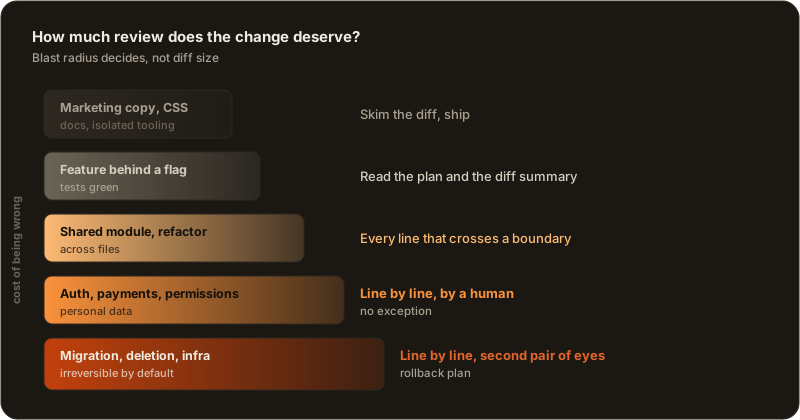
The size of the diff tells you how long review takes. The blast radius tells you whether it is optional.
The rows are not about trust levels. They are about the cost of being wrong, which is a property of the code and not of who wrote it. That is what makes the table usable: nobody has to agree on how good the agents are in order to agree on the table. If your team is deadlocked on the philosophical question, skip it and negotiate the rows instead. You will be surprised how fast that converges.
If your product handles personal data in Europe, one more row is written for you by law rather than by taste: what an AI-built feature has to respect under GDPR is not a judgement call, and "an agent wrote it" has never been a defence.
What changes when five agents run at once
Everything above assumes you can see the change. With parallel agents, that assumption breaks first, and it breaks in a specific way: the diff stops having a single author. Three agents have touched the working tree since your last commit, and the question "who changed this file, and as part of which task" no longer has an obvious answer. Review without attribution is not review, it is archaeology.
That is a tooling problem, and it is the reason AgentsRoom puts review where the agents are rather than at the end of a pull request:
- Review Mode shows every change your agents made, as a readable diff, before anything is committed. It is the "read the diff in proportion to blast radius" step, made cheap enough that people actually do it.
- Per-agent review filters that diff by agent and lets you commit each agent's work separately. Five parallel agents become five reviewable units instead of one unreadable working tree, and a bad change stays attributable to the task that produced it.
- The commit message is generated from the real diff with the sparkle button on the commit field, so history describes what changed rather than what the agent said it was doing. That distinction matters at 3am, six months later.
None of this replaces judgement. It removes the excuses for not exercising it.
Make the machine own the lines
If you want to stop reading lines, something else has to read them. In practice, four things carry that load:
Tests the agent did not write in the same breath as the code. Written first, or written by a different agent, or at minimum reviewed as their own change. The moment code and its tests come from the same generation, they stop being independent evidence.
A reviewer with a different model. This is the practical answer to the correlated failure problem. If a second agent reviews, run it on a different provider or model family than the author. You will not decorrelate the errors completely, but a Codex-family reviewer on Claude-written code catches a measurably different class of problem than a same-model reviewer, precisely because it does not share the author's priors.
Gates that do not get tired. Types, lint, secret scanning, coverage floors, a CI that refuses a migration bundled with a feature. Every rule you can express as a gate is a rule you never have to notice again.
A loop that closes on itself. An agent that builds, runs its own work against the plan and iterates before handing anything over removes the entire category of "did not even run" from your review. That is the self-correcting agent loop, and it is the difference between an agent that produces a diff and one that produces a result. It does not answer the question of whether a human should sign. It just means the human is signing something that already works.
So, do you still review?
Yes, and less than you do today.
Stop reading lines to feel responsible. Read the plan before, because that is where the expensive mistakes are made. Read the diff after in proportion to what it can break, using the ladder rather than your mood. Keep a human, personally, on auth, payments, permissions, personal data and anything irreversible, because a model cannot hold accountability and a second agent shares the first one's blind spots. Give everything else to tests, types, gates and a reviewer that does not share the author's model.
The teams that get this wrong fail in one of two directions, and both are avoidable. One reviews everything, becomes the bottleneck, and quietly starts approving without reading, which is the worst of both worlds. The other reviews nothing, ships fast for two months, and then spends a quarter paying down debt it never saw accumulate.
The debate at your standup is not really about whether agents are good. It is about who is willing to sign. Answer that, and the review policy writes itself.
Frequently asked questions
Should you still review AI generated code?
Yes, but not line by line on everything. Review the plan before the agent starts, then review the diff in proportion to what the change can break. Marketing copy and CSS get a skim. Auth, payments, permissions, personal data and migrations get read line by line by a human, every time.
Can an AI agent review another AI agent's code?
It helps, but it is not a substitute for a human on risky code. Two agents from the same model family, given the same context, tend to fail in the same direction. Their errors are correlated, so a second agent catches typos and missing tests but shares the blind spots that produced the bug. If you do use an agent reviewer, run it on a different model than the author.
How do you know if an AI agent made a mistake?
Look for objective tells in the diff rather than reading for style. The strongest one: tests changed in the same commit as the code they cover, which means the green was constructed and not observed. Others include scope creep, a disabled or weakened assertion, an invented API, a hardcoded local path and a summary that does not match the diff.
Will AI agents replace human code reviewers?
They already replaced most of the line reading. They cannot replace the signature. Accountability does not transfer to a model, so a human still owns the decision to merge on anything that is hard to reverse.
Do you need to review AI code line by line?
Only where the blast radius justifies it. Line by line review does not scale past a few agents running in parallel, and a human skimming a 900 line diff at 6pm produces a signature without producing knowledge. Spend that attention on the changes that are expensive to undo.
What should never be merged without human review?
Anything touching authentication, payments, permissions, personal data, database migrations, deletion paths and infrastructure. These share one property: the cost of being wrong is not proportional to the size of the diff.
Download AgentsRoom
Run all your AI agents, on all your projects, from a single window.
Companion app: monitor your agents on the go
Bring your own: Claude, Codex, Antigravity CLI, or other AI provider.
Push bugs and requests straight to your public backlog.
Keep reading
Agents Write the Code Now. Here Is What the Developer's Job Became.
Writing code was one link in a six-link chain, and it is the link agents took. The other five got heavier. A walkthrough of the job that is left: hearing what to build, deciding, briefing, running, reviewing, shipping.
Read the articleAI Agent Loops: How Self-Correcting Coding Agents Finish the Job
An AI agent loop turns prompt-and-fix into a self-correcting cycle: the agent writes a plan, builds it, reviews its own work against the plan, and loops until it is done. How the loop works in Claude Code, Codex, Antigravity CLI, Cursor and the Ralph loop.
Read the articleWhich AI Agent Should You Pick for Your Projects?
A frontend agent writing your marketing copy is a silent failure. How to match every task to the right AI agent: roles, catalog experts, custom agents, and what to do when you have no idea who should take the job.
Read the article