The right AI model for every task,
picked automatically, before you send
Adaptive Mode reads the prompt you are about to send and suggests the most cost-effective model for the job. A typo fix or a translation routes to a light, cheap model. A big refactor or an architecture design routes to a flagship. You pick only the power you actually need.
Smaller models cost a fraction of the flagship. Right-sizing the model for each task means you burn far less of your plan's budget per task, so you run more tasks per day without hitting a usage wall. One click applies the suggestion and you keep working.
Adaptive Mode matches each task to the cheapest model that can do it well: Haiku for light work, Sonnet for balanced work, Opus for heavy work. Less cost per task, more tasks per day.
Here is the money problem with running AI coding agents. Every model has a price, and the gap between the cheap one and the flagship is large. Claude Opus is the most capable model, and the most expensive. Claude Haiku is the cheapest. Claude Sonnet sits in the middle. Most people pick one model and leave it there, so they either underpower their hard tasks or, far more often, overpay for their easy ones.
Think about what you actually ask an agent to do in a day. Fix a typo. Rename a variable. Translate a UI string. Write a short unit test. Summarize a document. None of that needs a flagship model. Run it all on Opus and you burn your plan's usage budget many times faster than you need to, for an identical result. That waste is invisible, which is exactly why it adds up.
Adaptive Mode closes that gap. Before you send your first message, it reads your draft, works out how hard the task really is, and suggests the cheapest model in your provider's lineup that can still do the job well. The heavyweight models stay reserved for the work that earns them: architecture, security audits, large refactors. Everything else routes to a model that costs a fraction as much.
Why match the model to the task
Stop overpaying on easy tasks. A flagship model on a typo fix is money set on fire. Adaptive Mode steers light work to a light model, so each trivial task costs a fraction of what it would on the top tier.
Keep the powerful model for the hard problems. Right-sizing is not about always going cheap. When the task is a system design or a security audit, Adaptive Mode tells you to switch up, so the work that needs depth actually gets it.
More tasks per day on the same plan. Less budget spent per task means you hit your usage limit later. Across a full day and a fleet of parallel agents, the savings compound into real extra throughput.
Zero workflow friction. The suggestion appears as a small chip above the composer before you send. One click applies it. No menus to hunt through, no manual guessing about which model fits, no slowing down.
The economics: consume less, do more
Same agents, same plan. The difference is how much of your budget each task eats.
One model for everything
- : Every task runs on whatever model you left selected.
- : A flagship model on a typo or a translation costs many times what it should.
- : Your plan's usage budget drains fast on work that never needed the power.
- : You hit the usage wall earlier in the day and the agents stall.
- : Switching model by hand is fiddly, so nobody bothers.
Adaptive Mode on
- : Each task is matched to the cheapest model that can do it well.
- : Light work routes to a light model and costs a fraction as much.
- : The flagship is saved for refactors, audits and architecture.
- : Less budget per task means more tasks before any usage limit.
- : One click applies the right model, so right-sizing actually happens.
The routing itself is near-free: a small, fast model does the analysis in well under a cent, then gets out of your way.
Say what the task is.
The agent opens on the right model.
AI Suggestion moves the same decision earlier, to the one moment where it costs nothing: before the session exists. You open an agent, and instead of a terminal you get a single field asking what this agent is about to do. You answer in one sentence. One call reads it and returns the model, the session name and, if you have not chosen an agent, which agent should take it.
Then the session opens, already set, with your sentence as the first message. You did not paste anything, you did not wait for the CLI to boot to correct it, and you did not pay flagship rates to fix a typo.
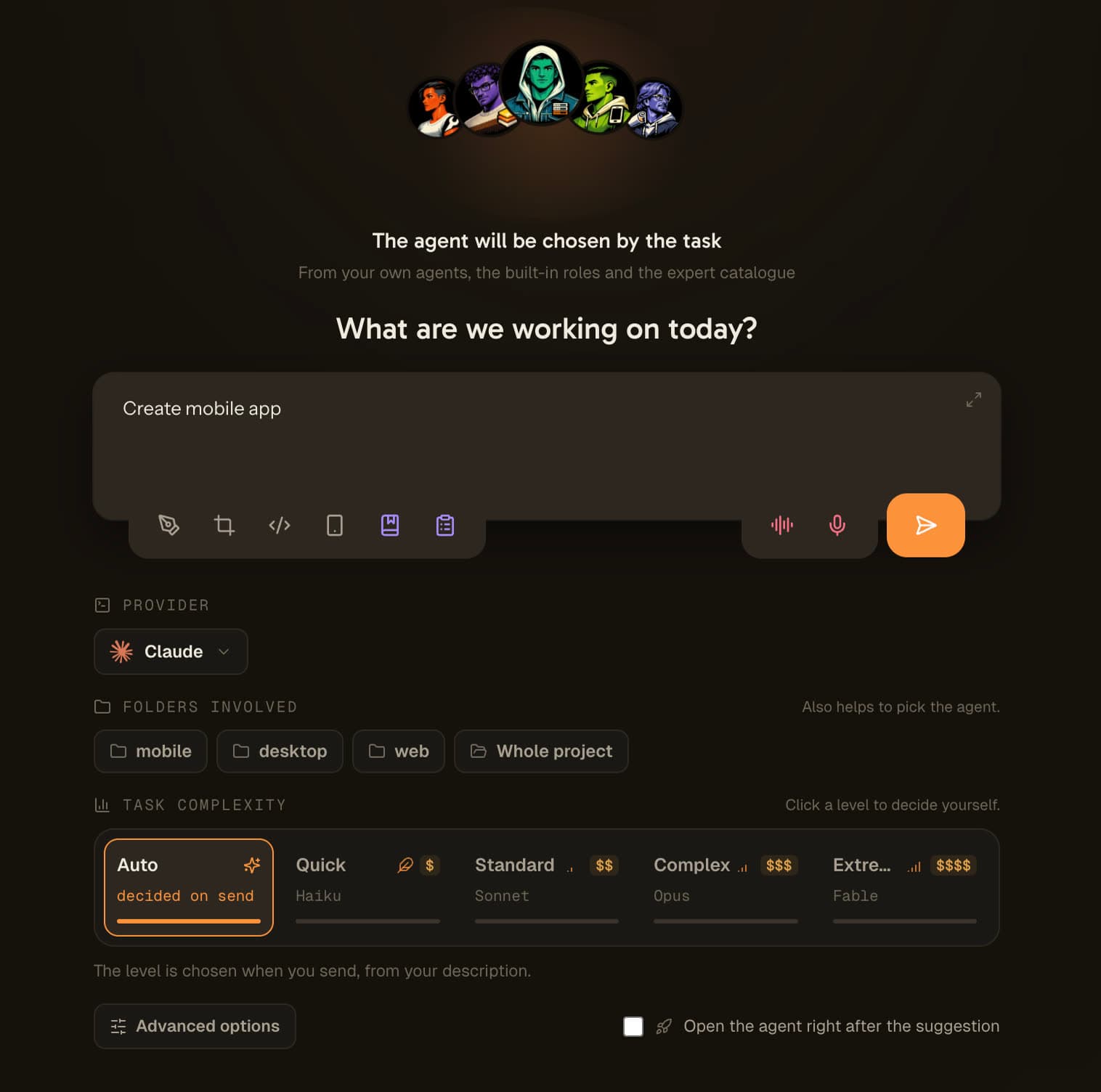
One sentence goes in. One complexity level lights up. The agent opens on the model that level maps to, with the session already named.
A real session, from an empty field to a running agent: one sentence describes the task, the complexity rail lands on Sonnet, the agent and the session name come with it, and the session opens with that sentence already sent.
Why the decision has to happen before the session opens
Same suggestion, same model, two very different outcomes. The only variable is when you are asked.
Asked after the terminal opened
- : The CLI has already booted on whatever model was configured.
- : Your prompt is written and you are one key away from sending it.
- : Switching model now means throwing away the session you just started.
- : The suggestion reads as an interruption, so it gets dismissed.
- : The flagship runs the trivial task anyway, and nothing is learned.
Asked before the session exists
- : Nothing has started yet, so there is nothing to undo.
- : You are already describing the task, which is the input the decision needs.
- : The model, the session name and the agent are settled in one call.
- : The session opens configured, with your description as the first message.
- : Choosing the cheap model costs you nothing, so it actually happens.
This is the whole idea. Not a smarter suggestion: the same suggestion, made at a moment when saying yes is free.
Four levels, mapped to your provider's real models
The complexity rail is the visible part of the decision. Leave it on Auto and the analysis lights one level up. Click a level yourself and it becomes your decision: nothing is sent, and the session opens immediately.
Quick
01Text or config edits with no logic behind them. A typo, a label, a translation string, a version bump. This is the level a flagship model should never see, and the one it gets the most often.
Standard
02A small change where the solution is already known. Add a state to a button, wire an existing component, write a short test. There is nothing to investigate, only work to do.
Complex
03A feature to build, a bug to investigate, a refactor to carry out. The path is not obvious at the start, so the model needs room to explore before it commits to an approach.
Extreme
04Architecture, an audit, a problem with no known cause. This is what the flagship model exists for, and reserving it for these tasks is what makes it affordable to use them here.
No model identifier is written into the feature. The four levels are resolved from the catalog of whichever provider the agent runs on, sorted from most to least capable. If that provider offers fewer than four models, the table folds upward: with three models, Complex and Extreme both land on the flagship, never the other way around. Under-sizing wastes a whole run; over-sizing costs the price difference of one call.
How AI Suggestion works, step by step
Six steps, four of them optional, and one call in total.
You open an agent
Instead of a terminal, you get the intent screen: the agent's face on an animated background, an arrow pointing at a single field, and a link at the top right to open the session directly if you are not in the mood.
You describe the task in one sentence
Plain language, in your own language. Not a prompt, not a spec: what this agent is about to do. That sentence is the only required input, and it becomes the first message of the session.
Optional: point at the folders involved
The project's folders are shown as small folder-shaped chips. Clicking one gives the agent its scope and sharpens the difficulty estimate, because the same bug in a mobile app and in a website are not the same task.
Optional: open the advanced options
Folded away under the field: the nature of the work, who it is for, the deliverable you expect, guardrails such as no commit or tests required, and free context like a pasted error or a ticket id. They travel in the same call and are prepended to the agent's first prompt.
One call decides, or no call at all
Left on Auto, sending triggers a single request that returns the level, the model, the session name and, when no agent is set, the agent. Click a level yourself instead and there is no request: the session opens straight away on the model that level maps to.
The session opens, already set
The agent starts on the chosen model, under the generated session name, with your description delivered as the first message through the CLI's own launch argument rather than pasted into the terminal after boot.
You do not even have to choose the agent
If you open the screen without naming an agent, the question widens. The orb shows a question mark ringed by three faces, and the sentence you type decides who takes the task: one of the agents already in your room, one of the fourteen built-in roles, or one of the 260 or so experts in the catalog.
This is also what a brand-new project gives you now. It no longer creates a full-stack agent silently just because something had to be created. It asks what you are working on, then picks the agent the answer calls for.
The agent, the model and the session name come back from the same single call, because chaining three requests would triple the latency of a screen whose entire value is that it is faster than opening the terminal and fixing the model afterwards.
One question after the session opens
Once the agent is running, a thin bar asks once: was the suggested model the right one? Three answers: it helped, too light, too heavy.
Three and not two, because 'that was wrong' is not usable. The direction of the mistake is. Too light and too heavy are opposite corrections, and only the direction tells the sizing policy which way to move.
The bar never blocks anything, it is asked once per session, and the answer is only sent when you have usage data sharing switched on.
Ignore it, skip it, or switch it off where it annoys you
A screen that stands between you and your terminal has to be trivial to get rid of. There are four ways out, and none of them is buried in a menu.
Open directly
A link at the top right of the screen opens the session exactly as it would have opened before the feature existed. No call, no analysis, no delay.
Decide the level yourself
Clicking a level on the rail turns it into your decision. No request is made at all, and the session opens immediately on the matching model.
Off for this agent, this project, or everywhere
The setting resolves agent first, then project, then application, so you can keep the screen for the agents where it pays and drop it for the ones you always open the same way.
Turned off from where you are
The three off switches are also in the 'Why this screen?' popover on the screen itself. You disable it at the moment it annoys you, not three menus later.
Automated agents never see the screen at all: QA bots, backlog tickets, scheduled tasks, mockups, team steps and temporary agents already carry their brief, and nobody is sitting in front of them.
How Adaptive Mode works, step by step
It runs once, before your first message, and never gets in your way.
You start typing your prompt
Open a fresh conversation with any agent and write what you want done. Adaptive Mode only looks at brand-new conversations, so it never interrupts a session that is already going.
It reads the task and analyzes it
Once your draft is substantial enough and you pause for a moment, Adaptive Mode sends the first part of your draft to a small, fast routing model that figures out how demanding the task is.
A model suggestion appears
A chip surfaces above the composer: 'Switch to Haiku', 'Switch to Sonnet' or 'Switch to Opus', whichever is the most cost-effective fit. If your current model is already the best choice, it tells you that instead.
You apply it in one click
Click the chip and the model is applied. If a session is already running, Adaptive Mode live-switches it. The choice is also saved to the agent, so the next launch starts on the right model.
Or recompute, or dismiss
Reworded your prompt? Hit refresh to recompute the recommendation for the new draft. Happy with your current model? Dismiss the chip and send. You stay in control of every call.
It stays quiet after that
Adaptive Mode suggests once per conversation, so it never nags you or quietly spends your monthly allowance while you keep editing. It does its job, then disappears.
Provider-agnostic model routing
Adaptive Mode reads the model lineup of whatever provider you are using and recommends from that catalog. It is not tied to one vendor.
Claude
Routes across Haiku, Sonnet and Opus. Haiku for quick fixes, renames, translations, short tests and summaries. Sonnet for pull-request reviews, new endpoints, complex debugging and refactors. Opus for system architecture, security audits, large legacy refactors and deep performance work.
Codex
Routes across the Codex lineup, from the fast, cheap mini model for small bugs and quick questions, to the balanced default for end-to-end features and tests, up to the flagship reasoning model for complex system design and deep code review.
Antigravity
Routes between the fast Antigravity model for small fixes, translations and summaries, and the capable Antigravity model for implementing features, debugging and deeper analysis.
Other providers
For any provider, Adaptive Mode falls back to a simple rule: the cheapest model for light work, a balanced model for normal work, the most capable model for hard work. Add a provider and it routes within that provider's own models.
FAQ
What is Adaptive Mode in AgentsRoom?
Adaptive Mode is smart model routing for your AI coding agents. Before you send your first message, it reads your prompt and suggests the most cost-effective model in your provider's lineup that can still do the task well. A light task gets a light, cheap model; a heavy task gets a flagship. The goal is simple: stop overpaying with a powerful model on work that does not need it.
How does Adaptive Mode pick a model?
It sends the first part of your draft to a small, fast routing model that has been guided with examples of which kinds of tasks suit which model tier. It then returns the cheapest model that fits the task, validated against the models your current provider actually offers. If your current model is already the best fit, it says the model is optimal instead of pushing a change.
How does this actually save me money?
Cheaper models cost a fraction of the flagship for the same simple task. If you run typo fixes, renames, translations and short tests on the top model, you burn your plan's usage budget many times faster than you need to. Adaptive Mode routes that light work to a light model, so each task costs less and you can run more tasks before hitting a usage limit. Across a day and many parallel agents, those savings compound.
Which models can it suggest?
Whatever your provider offers. On Claude that is Haiku, Sonnet and Opus. On Codex it spans the fast mini model, the balanced default and the flagship reasoning model. On Antigravity it spans the fast and the capable models. For other providers it falls back to cheapest, balanced and most capable. Adaptive Mode reads the live model list, so it always recommends a model you can actually run.
Does it switch the model automatically?
No. Adaptive Mode only suggests. You apply the change with a single click on the chip. If a session is already running it switches the model live; in every case the choice is saved to the agent so the next launch starts on the right model. You can also dismiss the suggestion and keep your current model.
When does the suggestion appear?
On a brand-new conversation, after you have typed a substantial prompt and paused for a moment. It runs once per conversation, so it never interrupts an ongoing session and never quietly spends your monthly allowance while you keep editing.
Can I recompute the suggestion?
Yes. If you rewrite your prompt, hit the refresh button on the chip to recompute the recommendation for the new draft. A manual recompute uses one of your monthly suggestions, so it is there when you want it without running on every keystroke.
Is my prompt private?
To compute a suggestion, only the first part of your draft is sent to AgentsRoom servers, once per conversation, and only when Adaptive Mode is enabled. You can turn the feature off entirely from settings if you prefer to choose models yourself.
Does Adaptive Mode work with Codex and Antigravity, not just Claude?
Yes. Adaptive Mode is provider-agnostic. It reads the model catalog of whatever provider the agent is using and recommends from that catalog, whether that is Claude, Codex, Antigravity or another supported provider. The model-switch command is built for the provider you are on.
How do I turn Adaptive Mode on or off?
It is off by default. Open the AgentsRoom settings, go to the composer options and tick Adaptive Mode to switch it on: the same checkbox switches it off. While it is off, nothing analyses your draft and nothing about it leaves your machine.
What is AI Suggestion in AgentsRoom?
AI Suggestion is a short screen shown before an agent session starts. You describe the task in one sentence, and a single call returns the cheapest model in your provider's catalog that can do the job, a session name, and, when you have not chosen an agent, the agent that should take it. The session then opens already configured, with your sentence as its first message.
What if I already know how hard the task is?
Click the level on the rail. That turns it into your decision, skips the call entirely and opens the session immediately on the model that level maps to. The screen is at its fastest when you already know the answer.
What happens if the call fails or I am offline?
The agent opens anyway, on the model it would have used without the feature. A dead network, a rate limit and an unusable answer all end the same way, because a screen that can stop you from opening an agent would be worse than no screen at all. When the machine is definitely offline, the screen is not shown in the first place.
Can it pick the agent as well as the model?
Yes, when you open the screen without naming an agent. The task is matched against the agents already in your room, the fourteen built-in roles and the expert catalog. It is also what a brand-new project does now, instead of silently creating a full-stack agent because something had to be created.
Goes well with
CLI Doctor
When Claude Code, Codex or any agent CLI dies at launch, AgentsRoom reads the error, the exact command it ran and where every launch flag came from, then explains what broke and how to fix it.
Agent Suggestions
Not sure which AI agent to use? Describe your task in plain language and AgentsRoom suggests the right agent: from your room, the 14 built-in roles or 260+ catalog experts, with a one-line reason. One click assigns the task.
Claude Code Token Usage
See token consumption and cost per session in real time. Pairs with Adaptive Mode: route smart, then watch the savings land.
Agent Delegation
A dev agent hands a test off to a cheaper QA agent through MCP. Same idea as Adaptive Mode, applied to whole agents.
Multi-Provider
Run Claude, Codex and Antigravity side by side. Adaptive Mode routes within whichever provider each agent is on.
Project Statistics
Time, prompts, tokens and cost per project and per agent. The dashboard view of the budget Adaptive Mode helps you protect.
Agent Status Tracking
Live status for every agent across every project, so you always know who is working and who needs you.
Restore Session
Quit and come back with every agent, terminal and model selection exactly where you left them.
Further reading
How to Cut Your Claude Code Token Costs Without Slowing Down
Claude Code bills you per token, and most of the spend is invisible: bloated context, the wrong model, raw PDFs, agents re-reading the same files. Here is where the money actually goes and how to cut it, with the habits and tools that keep your bill low without slowing you down.
How to check Claude Code token usage: 4 ways to see what your agents spend
Four ways to check Claude Code token usage: the /cost command, the session transcripts, the ccusage CLI, and a live per-session meter. See exactly what each agent spends.
Which AI Agent Should You Pick for Your Projects?
A frontend agent writing your marketing copy is a silent failure. How to match every task to the right AI agent: roles, catalog experts, custom agents, and what to do when you have no idea who should take the job.
Stop overpaying for AI model power you don't need
Download AgentsRoom and let Adaptive Mode pick the most cost-effective model for every task. Light models for light work, flagships for the hard problems, less budget burned per task, more tasks shipped per day.
Companion app: monitor your agents on the go
Bring your own: Claude, Codex, Antigravity CLI, or other AI provider.
Push bugs and requests straight to your public backlog.