AI Agent Loops: How Self-Correcting Coding Agents Finish the Job
An AI agent loop turns prompt-and-fix into a self-correcting cycle: the agent writes a plan, builds it, reviews its own work against the plan, and loops until it is done. How the loop works in Claude Code, Codex, Antigravity CLI, Cursor and the Ralph loop.
The way most people still use an AI coding agent looks like ping-pong. You prompt, it answers, you spot what is wrong, you prompt again. You are the correction engine, and you sit in the loop on every single turn.
A loop flips that. You describe what you want, the agent gets to work, writes its own checklist, finds its own weak spots, and runs again until the result holds up. You stop being the thing that catches mistakes. The agent catches its own.
That shift is not hype. The people who built these tools lean on it. Boris Cherny and Cat Wu, the creators of Claude Code, talk about coding in agent loops. Geoffrey Huntley, who named the "Ralph loop", runs agents in a plain while loop overnight. The pattern has a name now, and it is worth understanding before you copy three prompts off Instagram.
From prompt ping-pong to a loop
A single prompt is a one-shot. You ask, you get an answer, the transaction ends. To improve it, you have to notice the gap and prompt again. Scale that to a real feature and you are doing dozens of micro-corrections by hand.
An AI agent loop closes that gap inside the agent. You set a goal, the agent plans, acts, looks at the result, and corrects, over and over, until the goal is met. You are not gone, you review at the end. But you are no longer the bottleneck on every iteration.
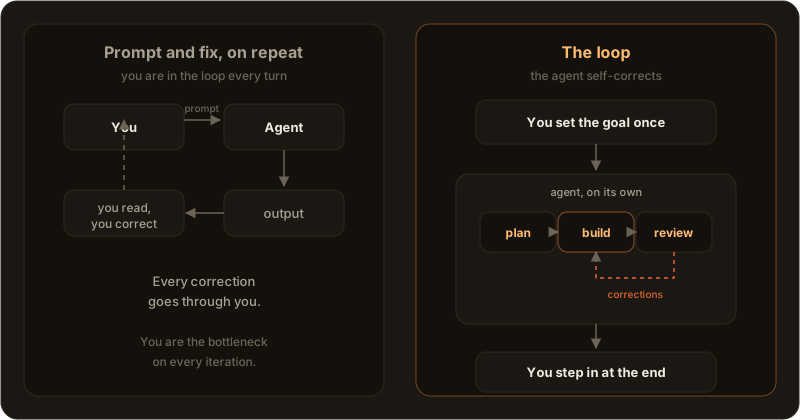
Prompt ping-pong puts you in the loop every turn. A real loop puts the agent in it.
What an AI agent loop actually is
Every agentic loop runs the same four beats: plan, act, observe, correct. The agent decides the next step, takes it (writes code, runs a command, reads a file), reads what happened, and adjusts. Claude writes code, runs the tests, sees a failure, fixes it, runs the tests again. That feedback is the whole trick. It is what makes the loop self-correcting instead of just repetitive.
The strongest version of the loop splits those beats across three roles: one that plans, one that builds, one that reviews. Keeping them separate is what stops the agent from grading its own homework in the same breath it writes it.
The three-command loop you can copy today
Here is the setup going around right now, rebuilt as three Claude Code slash commands. Paste each one once, the agent creates the command, then you run them in order.
The planner, /spec:
Interview me one question at a time until you fully understand what I want.
Then write a precise plan to specs/project.md: the objective, the exact
requirements, the edge cases, and what is in scope versus out of scope.
Keep it short and sharp, not a novel.
The builder, /build:
Read specs/project.md and build exactly what it describes, nothing more.
When you are done, list every requirement from the plan and mark which
ones you covered.
The reviewer, /review:
Compare what was built against specs/project.md, requirement by requirement.
For each one, say whether it is covered. Write the corrections needed and
hand them back to /build. Only sign off when the whole plan is covered.
Three commands, one loop: spec writes the plan, build implements it, review checks it against the plan and sends corrections back to build. It keeps cycling until every requirement is met.
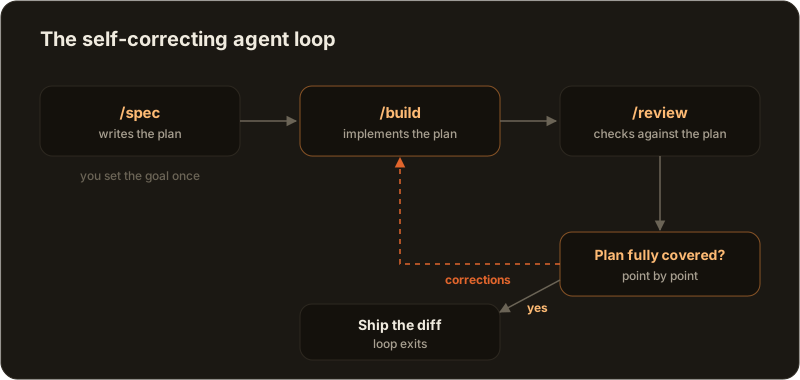
The plan is the source of truth. Review measures the build against it, not against a vibe.
This is spec-driven coding under the hood: the written spec, not the chat history, is what the agent is held to. GitHub's open-source Spec Kit formalizes the same idea with /specify, /plan, /tasks and /implement, and it runs on Claude Code, Copilot, Cursor, Codex CLI and Antigravity CLI alike.
Why a fresh context makes the loop work: the Ralph loop
Geoffrey Huntley named the bluntest version of this in mid-2025: the Ralph loop. The idea is a plain shell loop that feeds the agent the same prompt against a written spec, lets it pick one task and ship it, then starts a brand new agent with a clean context and feeds the identical prompt again.
while has_more_todos; do
  agent --prompt "Work on the next task from todo.md" --non-interactive
done
The non-obvious part is the context reset. A long session rots: the window fills with old reasoning, dead ends and stale file contents, and the model quietly starts dropping instructions. Each Ralph iteration is a new agent that reads the current repo and todo list from disk, does one unit of work, commits, and exits clean. Huntley named it after the Simpsons character on purpose, it looks too dumb to work, and it works. If you have watched a long session start hallucinating, you already know why a fresh window beats a bloated one.
Claude Code's /loop and /goal
Claude Code ships loop primitives directly. /goal sets a persistent end state, what "done" looks like, and Claude evaluates progress against it after each pass instead of just running the next step. /loop repeats a task on a cadence or until a condition holds, with forms like /loop every 10m or /loop until: <condition>. Used together they create a self-directing, self-terminating loop: Claude works the delta between current state and goal, and stops when the goal is satisfied or you hit Ctrl+C.
The detail that matters: a loop keeps continuity. It remembers what it tried and why it failed, so each pass builds on the last instead of repeating the same dead end. That is the opposite trade-off from Ralph's clean-context reset, and both are valid. Continuity for tight self-correction, fresh context when the window is rotting. Knowing which to reach for is the actual skill.
The same loop, every provider
Loops are not a Claude feature, they are where the whole field is heading. The names differ, the shape does not.
| Tool | Loop mechanism | How it self-corrects |
|---|---|---|
| Claude Code | /goal + /loop | Persistent goal, evaluates the delta each pass, stops when met |
| Codex CLI | /goal | OpenAI's "take on the Ralph loop": keeps a goal alive across turns until reached |
| Antigravity CLI | agentic plan-act-observe | Plans, edits, runs checks, self-corrects without per-step approval |
| Cursor | agent mode | Plans steps, edits files, runs the compiler, fixes what it broke |
| Spec Kit (any agent) | /specify /plan /tasks /implement | Spec is the source of truth across the loop |
| Ralph / autoloop | shell while loop | Fresh agent per iteration against a written spec |
Codex CLI took the loop the furthest in public. OpenAI's team framed its /goal as their take on the Ralph loop, and a16z's Andrew Chen left it running overnight on a device driver for 14 hours straight without intervention. He also noted it would "10,000x token use", which is the honest cost of letting an agent grind for half a day.
The catch: a loop amplifies everything
A loop does not just amplify good output, it amplifies a bad plan too. Point a self-correcting agent at a vague spec and it will confidently build the wrong thing, review it against the same vague spec, and sign off. The plan is the lever. A sharp spec saves ten prompts, a fuzzy one wastes a hundred.
Two failure modes to watch. Cost runs away, every iteration burns tokens, and an unbounded loop on an unclear goal can burn a lot. And the loop can loop forever, declaring victory or chasing a target it can never satisfy. Bound it: a clear until condition, a token ceiling, or a human checkpoint before merge. A loop without a stop is not autonomy, it is a runaway.
That human checkpoint raises the question every team ends up arguing about: should you still review your AI agent's code, and on what criteria do you decide the agent got it wrong?
Running loops across a fleet
One self-correcting agent is easy to babysit. The leverage shows up when you run several at once, each looping on its own task, and that is exactly where watching a terminal stops scaling.
That is what AgentsRoom is built for. It is a multi-agent cockpit: every agent has a role, a live status dot and its own color, and you supervise the whole fleet from one window. Drop a ticket on the backlog and an agent picks it up, runs its plan-build-review loop, and hands you a clean diff. That is spec-driven AI coding in practice: the ticket is the spec, the agent runs the loop, you review the result.
Because long loops rot context, AgentsRoom watches for it. Each agent writes a one-line status at the end of every turn, and when an agent stops updating it for two turns in a row, a warning appears with a one-click restart on a clean context, the same fresh-window reset the Ralph loop relies on. Read how that works on the context drift detection page.
And because the loop is provider-agnostic, you are not locked to one. Run one ticket on Claude Code, the next on Codex, another on Antigravity CLI, all in the same dashboard, each looping in its own git worktree so parallel agents never collide. Set them off before you log off and review the diffs in the morning, that is the whole point of background coding agents and the night shift.
Set the goal once, let the loop close it, review at the end. Download AgentsRoom, check the provider compatibility matrix, and read more about per-agent review and multi-provider support.
Download AgentsRoom
Run all your AI agents, on all your projects, from a single window.
Companion app: monitor your agents on the go
Bring your own: Claude, Codex, Antigravity CLI, or other AI provider.
Push bugs and requests straight to your public backlog.
Keep reading
A Review Agent Should Not Be Able to Write. Here Is How We Enforce It, CLI by CLI.
In a 17 node run, the release agent edited a test to turn a red suite green, then two review agents wrote the same fix and collided. The prompt said review only. It did not hold. Here is the incident, why a written instruction cannot carry that rule, and the exact flags that make Claude Code, Codex, Grok, Antigravity and OpenCode refuse to write.
Read the articleTen Agents Ran the Same Type Check at Once. The Fix Was a Directory.
Seventeen coding agents in one checkout, ten tsc processes at the same time, load average 37 and 87 MB of free RAM. A ninety second type check took 7 minutes 36. Here is the measurement, why the machine was not computing, and the small shared lock that fixed it. Copyable into any repository.
Read the articleBest terminal for agentic coding in 2026: cmux, Warp, tmux, and what actually wins
cmux, Warp, tmux, WezTerm, AgentsRoom: an honest comparison of the best terminal for agentic coding and vibe coding when you run AI agents in parallel.
Read the article