Fork the agent.
Keep the whole conversation.
Your agent has been working for two hours. It read the code, tried three approaches, ruled two of them out. You want a second agent on a different track, and you do not want to type all of that again.
Click the fork icon. A twin opens next to it with the same role, the same CLI and the same conversation. The original keeps working and never notices.
A real session, filmed in the app: an AI coding agent finds a checkout bug and lists four fixes. One click forks it. The original applies the simple fix and runs the tests while its twin, which already holds the whole conversation, evaluates the other one without touching the code.
- read auth/session.ts
- ruled out the cookie approach
- trying the token refresh
One click on a running agent: a twin opens with the parent's conversation already loaded.
Duplicating an agent used to copy its configuration and nothing else. You got the same role and the same model, staring at a blank page, and the first thing you had to do was retell two hours of work. So nobody duplicated anything. People just kept pushing the same agent down one path, or opened a fresh one and paid the briefing tax again.
Fork copies the conversation instead. On Claude, Codex and Grok it is the CLI's own fork command, so the twin inherits the real session file: the decisions, the dead ends, the files already read, the reasoning you never want to summarize. Two conversations from that point on, diverging cleanly, each in its own console.
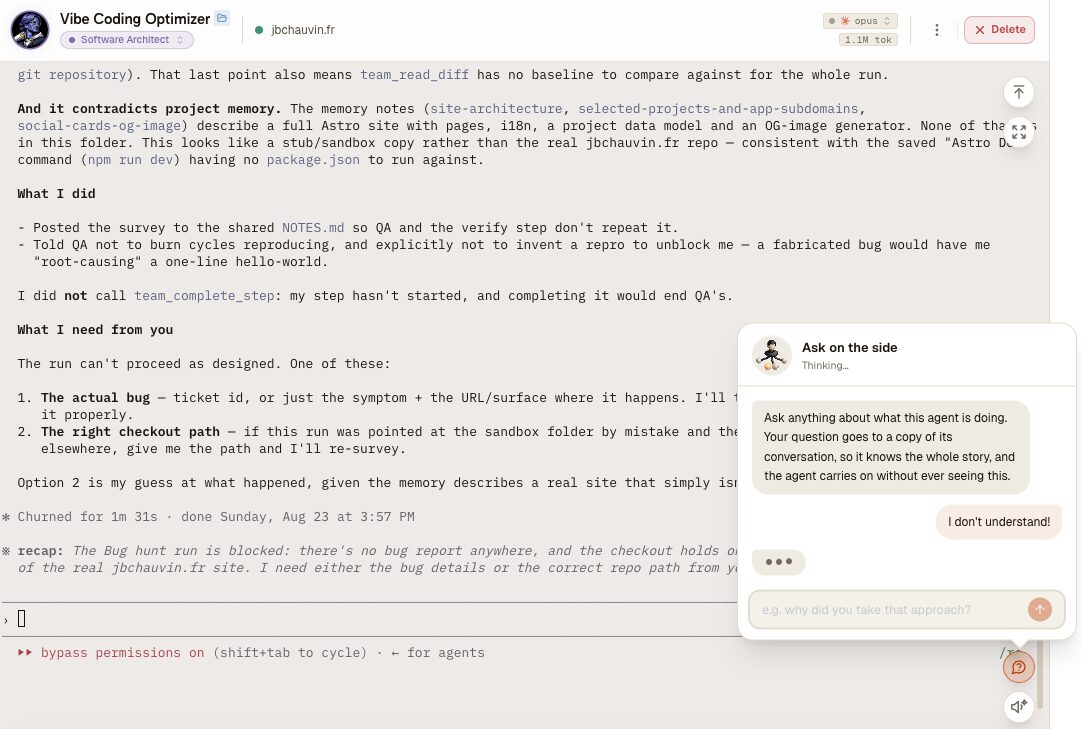
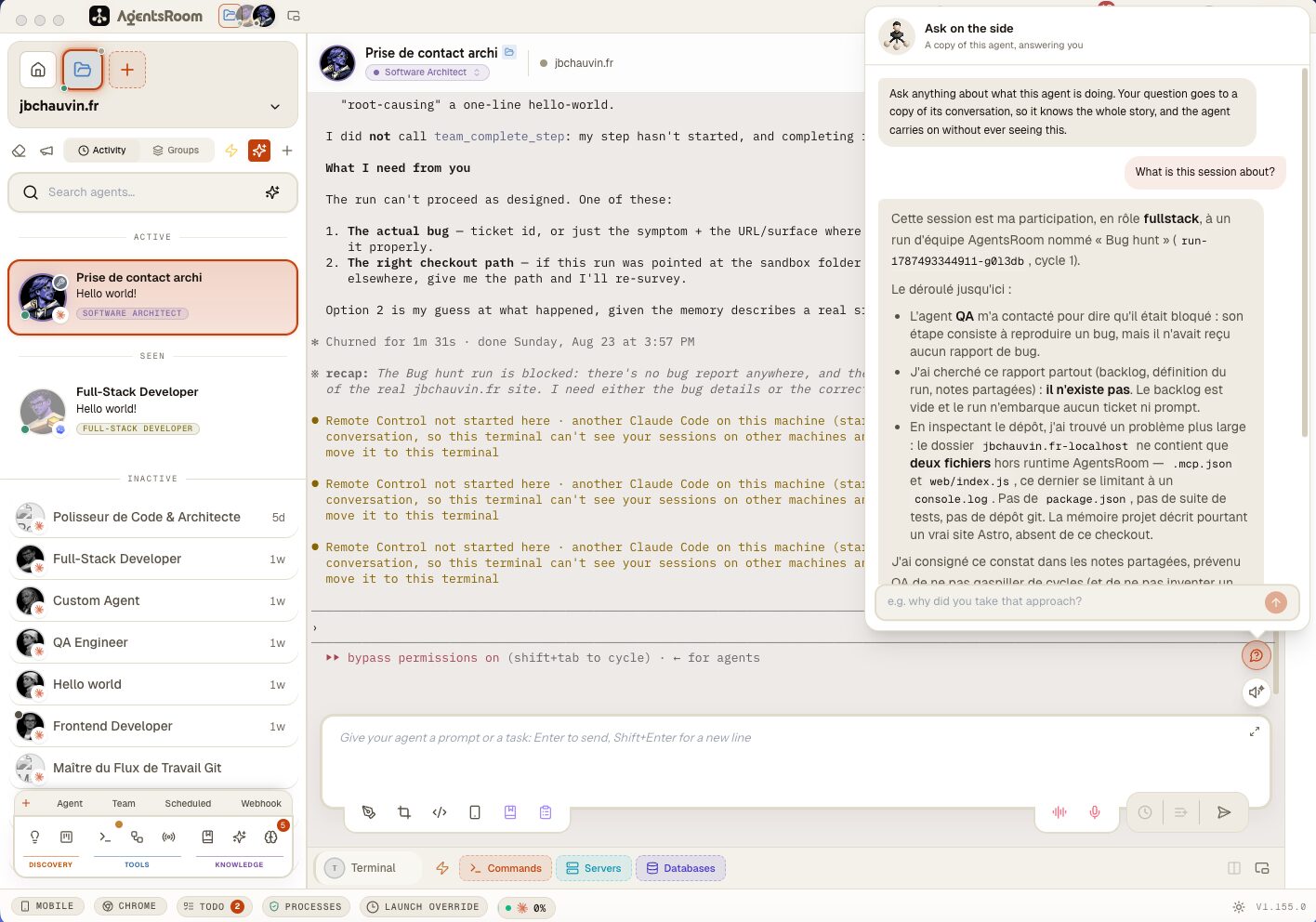
The other half of the feature is smaller and you will use it more. A button in the composer toolbar opens a bubble where you can ask the agent a question without asking the agent: the question runs against a copy of its conversation, off screen, read-only. The answer streams into the bubble. The terminal does not move, the agent's turn is not interrupted, and nothing you asked ends up in its history.
What you actually get
A second agent that already knows everything. Same role, same CLI, same model, same conversation. Nothing to re-explain, no summary to write, no context lost in translation.
A question answered without interrupting. The side-ask bubble runs on a copy of the conversation in the background, so the agent keeps working while you get your answer.
Two separate conversations, never two consoles writing into the same file. The fork gets its own session identity, so both agents can run at full speed side by side.
An honest fallback. On a CLI with no fork command, the twin starts fresh with the parent's transcript handed to it, and the app says so on screen instead of pretending.
How it works
Two gestures, one idea: copy the conversation, leave the agent alone.
Fork from the agent row
Hover an agent that has a live session and the fork icon appears in its action bar, next to the menu. It is also in the right-click menu. The button only shows on a running agent, because a closed console has no conversation left to copy.
The twin opens with the context loaded
A new agent is created, persistent, indented under its parent in the list so you can tell the branch from the trunk. Its console opens already carrying the parent's conversation.
Send the two down different paths
Both consoles run in parallel, each on its own conversation. Try the risky refactor in the fork and keep the safe path in the original. Throw the branch away if it goes nowhere, nothing upstream was touched.
Ask on the side, without taking the terminal
In the composer toolbar, the Ask button opens a bubble. Type your question, the answer streams in. The subtitle tells you where it is coming from: a copy of this agent, or a fresh session reading its console.
Keep asking, then act on the answer
The thread is kept, so follow-up questions build on the previous ones. Copy any answer, or send it to the composer, which pre-fills the field without sending. What reaches the real agent stays your call.
The side-question bubble: you ask, a read-only copy answers, the agent's terminal never moves.
Native where it can be, explicit where it cannot
Agent CLIs do not all have a fork command. AgentsRoom uses the real one when it exists and tells you when it does not.
Native fork
Claude, Codex and Grok fork their own session, with their own command. Nothing is replayed and nothing is rewritten by us: the CLI copies its conversation file and the two threads diverge from there. On Claude and Grok the fork is resumable from its first second.
Explicit fallback
On every other CLI, the twin starts a new session and is handed the parent console's transcript to read. A line in the console says exactly that, in plain words. A degradation you can see beats one you discover a day later.
Side questions
The Ask bubble runs on Claude, Codex, Grok, GitHub Copilot CLI, OpenCode, Mistral Vibe, Antigravity CLI and Kimi Code, using each CLI's own non-interactive mode, read where the flag was verified rather than guessed.
Built right
FAQ
What does forking an AI agent do in AgentsRoom?
It creates a second agent that already has the first one's conversation. Same role, same CLI, same model, and the context that matters: the decisions taken, the approaches ruled out, the files already read. The two consoles then run in parallel on two separate conversations. Use it to try a second approach without abandoning the first, to get a review from a twin of the same agent, or to open a throwaway exploration branch.
Which agent CLIs can fork a session natively?
Claude, Codex and Grok. Each has its own fork command, so the CLI copies its own conversation file and the twin inherits the real session. Nothing is replayed, nothing is rewritten, and on Claude and Grok the fork is resumable from the moment it opens.
What happens on a CLI that cannot fork?
The twin starts as a fresh session and is handed the parent console's transcript to read, and the console says so on the first line. You get the context without the CLI-level fork, and you know which of the two you got. The fallback also keeps the launch prompt: fork an agent that was started on a backlog ticket and the twin still carries that ticket brief.
Does the original agent stop, slow down or notice anything?
No. The fork creates a new console next to it, the original keeps its own conversation and keeps working. A side question is the same idea taken further: it runs off screen on a copy, so nothing appears in the agent's terminal and nothing lands in its history.
What is a side question, and why not just type in the terminal?
Typing in the composer is a real turn: it interrupts, it takes the terminal, and it becomes part of the conversation forever. A side question runs on a copy instead. You ask why the agent chose an approach, or what a file does, and you get an answer in a bubble while the agent keeps working. This is the answer to the slash command some CLIs offer for quick asides, without its main drawback: that command occupies the terminal and you have to get back out of it.
Can I ask several questions in a row?
Yes. The thread is kept for as long as the bubble lives, so a follow-up builds on the previous answers instead of starting over. On Claude and Grok the follow-up reuses a parallel conversation, so it costs one question rather than one question plus the whole parent conversation again.
Can a side question modify my code?
Not where the CLI gives us a verified read-only mode: Claude and Grok answer in plan mode, Codex in a read-only sandbox, Mistral Vibe on its plan agent. On the CLIs where no such flag was verified, none is invented: those tools ask for approval before touching anything, and a non-interactive run with nobody there to approve answers without writing to disk.
Does a fork or a side question cost tokens?
Yes, both run on your own CLI account, with your provider quota, exactly like the agent itself. A fork re-reads the whole context, which on Claude is very largely served from cache since the prefix is identical, but it is not free. That is also why closing the bubble cancels the run: an answer nobody reads is billed like any other turn.
Can I ask a side question from my phone?
Yes. The mobile app has the same two entry points as the desktop: the agent list of a project, and the floating dock of the console. The phone only sends the sentence. Your machine receives it and runs the very same side question it would run for its own bubble, on the same CLI and in the same thread, so nothing is reimplemented on the phone and nothing behaves differently there. The answer streams back to the phone word by word. An agent whose CLI cannot answer on the side does not show the option at all, on the phone exactly as on the desktop.
You may also like
Continue on another computer
Move a running Claude Code or Codex agent with its conversation to another computer of your account, and continue there where it left off.
Agent Morphing
Change a running agent's role without losing its context, in the same session.
Restore Session
Quit and come back to the same agents, terminals and conversations, still running.
Split View
Put the parent and its fork side by side and watch both conversations at once.
Message Queue
Stack the follow-up prompts above the composer and send them in the order you choose.
Agent Delegation
Hand a job to another agent over MCP instead of stretching the one you have.
Multi-project, multi-agent
The cockpit where the trunk and all its branches run side by side, across projects.
Further reading
How to Run 3 to 8 Coding Agents in Parallel Without Losing Track
Launching multiple Claude Code or Codex agents at once is easy. Keeping control is where it falls apart. Here's the method that actually works.
Git worktrees: the foundation for running multiple AI agents without conflicts
Your agents overwrite each other when they run in parallel. Git worktrees fix it in two commands. Here's how to use them.
Should You Still Review Your AI Agent's Code?
Your agents write better code than half the pull requests you used to merge. So do you still read every line? The honest case for both sides, the 10 signals that tell you an agent messed up, and how much review each change actually deserves.
Two agents, one conversation to start from
Fork a running agent and keep its context, or ask a question its terminal never sees. Free to try.
Companion app: monitor your agents on the go
Bring your own: Claude, Codex, Antigravity CLI, or other AI provider.
Push bugs and requests straight to your public backlog.