Looking for a Hermes Agent alternative? Meet AgentsRoom.
Hermes Agent is a free, open-source agent by Nous Research under the MIT license: it has its own loop, remembers across sessions, writes its own skills and answers from Telegram, Discord or Slack. AgentsRoom takes another route: it is not an agent. It runs each agent CLI exactly as its vendor ships it, in its own terminal, and organizes the work around it with a backlog, specialized roles and agent teams.
The two overlap more than their names suggest: both have a desktop app, a task board that starts agents, git worktrees, a diff review, scheduled runs and remote machines. The difference is what does the work. In Hermes, it is Hermes, on the model you pick. In AgentsRoom, it is Claude, Codex, GitHub Copilot CLI, Cursor and 15 other agent CLIs, side by side.
The difference at a glance
With Hermes Agent
- Free and open source under the MIT license; you pay for the model, directly or through Nous Portal
- One agent of its own, on the model you pick from dozens of providers, local endpoints included
- A learning loop: memories, skills it writes after complex tasks, search across past sessions
- A gateway to Telegram, Discord, Slack, WhatsApp, Signal and more, from a single process
- A desktop app, a web dashboard, a Kanban board, Bots, cron, and backends for Docker, SSH and serverless
- Phone apps still in beta with a waiting list, as of November 2026
With AgentsRoom
- Every agent runs its vendor's real CLI in its own terminal: every slash command, plugin and setting of the CLI works as is
- Claude, Codex, GitHub Copilot CLI, Cursor and 15 other agent CLIs, side by side in one window
- A Kanban backlog: you write the ticket, an agent picks it up with the right role and model
- 14 specialized roles and agent teams on a visual canvas, where Dev hands over to QA
- A diff review split by agent: see what each one changed and commit it on its own
- Native iOS and Android apps over an end-to-end encrypted relay: a push when an agent is blocked, and you answer it
One agent, or the vendors' CLIs
This is the choice that decides everything else, because it decides what does the work.
Hermes Agent is the agent
Hermes has its own loop, tools and memory, and calls the model you chose directly: Nous Portal, OpenRouter, an API key, your own endpoint. It can reach Claude Code or Codex through its skills, as a terminal command it drives, and its own documentation says that wiring those CLIs as Kanban workers is not yet a paved path. What you work with all day is Hermes, whichever model sits behind it.
AgentsRoom runs the agents you already use
AgentsRoom starts the CLI you already have, in a real terminal, and adds a live status on top: working, waiting for you, done. Nothing sits between you and the agent, so a new CLI feature works the day its vendor ships it, and you can type into any terminal at any moment. Claude Code keeps its own sign-in, its CLAUDE.md and its plugins, and Codex keeps its own. The organization happens around the terminals: projects, roles, tickets, teams and notifications.
Each question has its own page
Feature-by-feature comparison
An honest Hermes Agent comparison starts with what Hermes does better. The first rows are its own, the middle ones are shared, and the last ones are where AgentsRoom goes further.
| Feature | AgentsRoom | Hermes Agent |
|---|---|---|
| Open source | ✗ | ✓ |
| Free with no caps | Free plan | ✓ |
| Writes and improves its own skills | Rules you validate | ✓ |
| Chat from Telegram, Discord, Slack or WhatsApp | ✗ | ✓ |
| Any model, API or local endpoint, with no CLI | Through each CLI | ✓ |
| Runs tasks in Docker or on serverless backends | Cloud Agents | ✓ |
| Visual interface | ✓ | ✓ |
| Agent status (working, waiting, done) | ✓ | ✓ |
| Multi-project management | ✓ | ✓ |
| Drag and drop organization | ✓ | ✓ |
| Model per agent | ✓ | ✓ |
| Task board that starts agents | ✓ | ✓ |
| Git worktree per task | Optional | Optional |
| Built-in diff review | ✓ | ✓ |
| Scheduled and webhook-triggered runs | ✓ | ✓ |
| Agents on remote machines over SSH | ✓ | ✓ |
| Memory across sessions | Per project | Per profile |
| Reusable skills | ✓ | ✓ |
| Voice | ✓ | ✓ |
| Notifications when an agent needs you | ✓ | ✓ |
| Another account takes over at a usage limit | ✓ | Credential pools |
| The vendor's CLI in its own terminal | ✓ | Its own agent |
| Agent CLIs run side by side | 17 | Through skills |
| Diff review split by agent | ✓ | By branch or last turn |
| Agent teams on a visual canvas | ✓ | Bots and Kanban |
| Specialized agent roles (14) | ✓ | Profiles you define |
| Native iOS and Android apps | ✓ | Beta, waiting list |
| End-to-end encrypted link to the phone | ✓ | Not documented |
What AgentsRoom adds around the agents
Hermes Agent is very good at being one agent that keeps learning. AgentsRoom is built for the moment you have a dozen agents from several vendors and need to know who does what, with what, and why.
The CLIs you already pay for
A Claude plan, a ChatGPT plan, a Cursor account: AgentsRoom starts each vendor's CLI, and each one bills as it normally does. There is no agent of ours in between and no tokens to resell. You can run Claude Code next to Codex on the same repository and compare what they do.
A review that knows who wrote what
Hermes Desktop has a real review pane: uncommitted, branch or last turn, with stage, commit and pull request. AgentsRoom answers the next question, the one you get with several agents on one repository: which of them changed this file? Each agent has its own tab, and you commit its work on its own.
Teams you can read
Hermes coordinates through delegation, Bots and a Kanban board, and they work. AgentsRoom draws the flow on a canvas, where Dev hands over to QA and QA to the reviewer, with flags that route the next step and checks that must pass, whatever CLI each step runs.
Roles ready to use
Every AgentsRoom agent can take one of 14 specialized roles, Frontend, Backend, QA, DevOps, Security and others, each with its own instructions, its default model and its color in the sidebar. In Hermes, you define each Bot as a profile.
Phone apps you can install today
The AgentsRoom iOS and Android apps show every agent and its status, push a notification when one is blocked or done, and let you answer. As of November 2026, the Hermes phone apps are in beta behind a waiting list; until then, its Webapp opens in a phone's browser.
A phone link that cannot be read in transit
AgentsRoom sends everything between the phone and the desktop through an end-to-end encrypted relay: the server passes the messages along without being able to read them. Hermes's documentation is open about its side: its Webapp on a local network is plain HTTP unless you put your own HTTPS address in front, and its relay is marked experimental.
See AgentsRoom in action
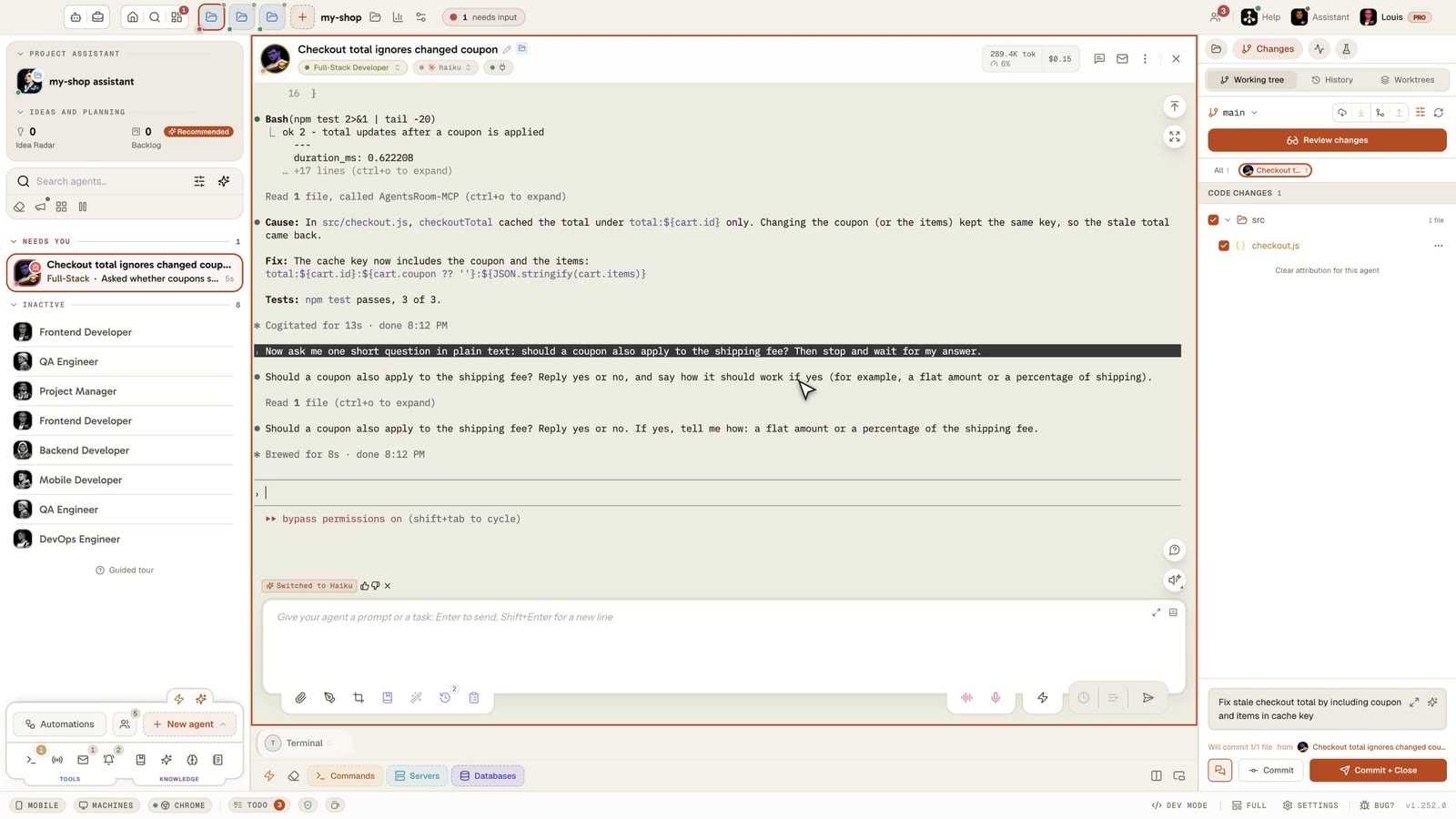
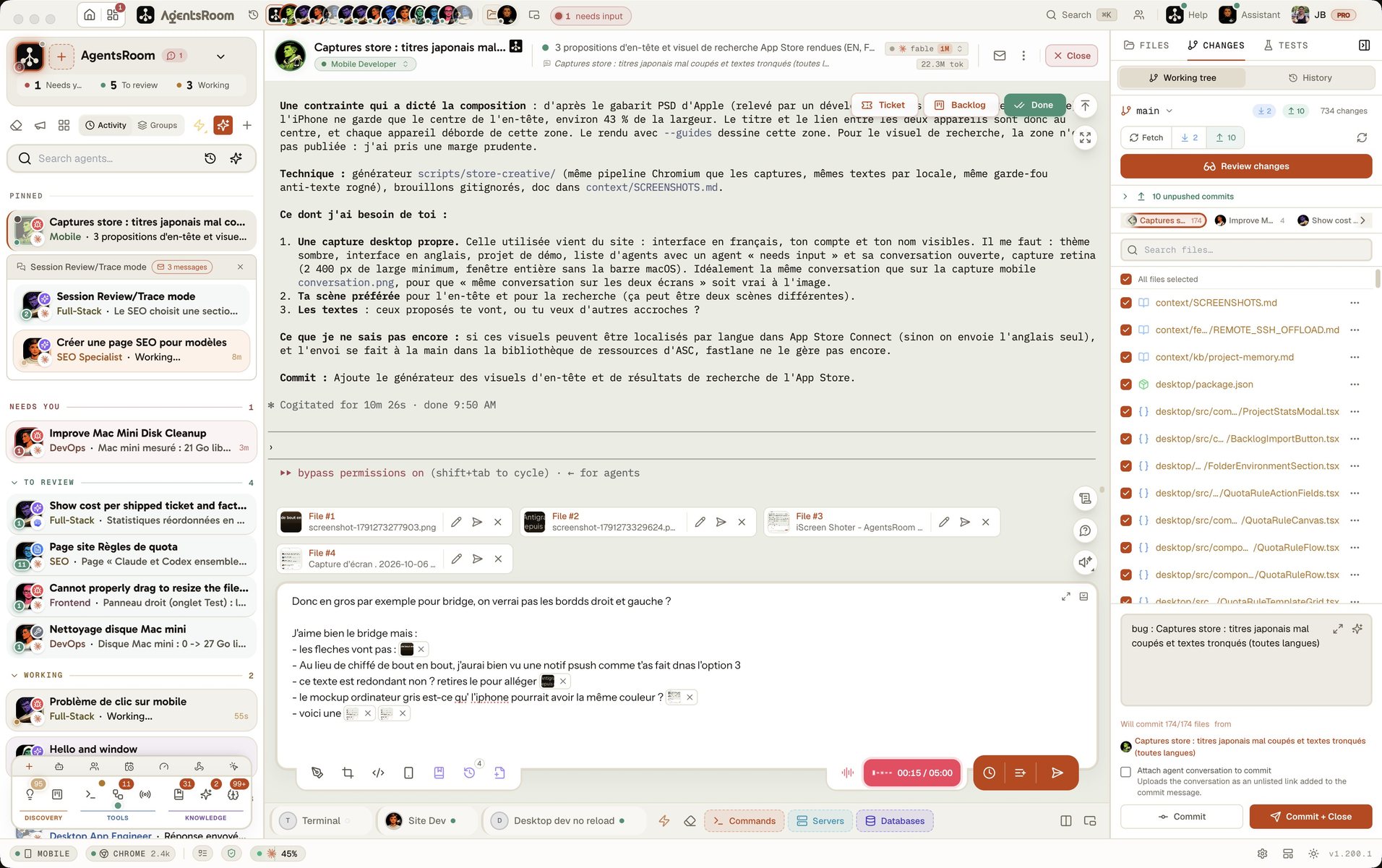
Watch how AgentsRoom drives several coding agents from a single window, with a backlog, specialized roles and one terminal per agent.
The desktop app, in Simple mode
On a phone the demo runs the real desktop app in its Simple interface mode: one project, its agents, one prompt. The full cockpit is on your computer.
When Hermes Agent might be the better choice
We believe in honest comparisons, and an alternative to Hermes Agent is not always what you need. Here are the cases where Hermes is the right tool and AgentsRoom is not.
You want one agent that keeps learning
Hermes keeps memories, writes a skill after a complex task, improves it as it uses it, searches its past sessions, and has a curator that tidies all of this on its own. AgentsRoom's project memory is shared by the agents of a project, and its Learning Loop proposes rules you validate. If you want a single assistant that gets to know you, Hermes is built around exactly that.
You want to talk to it from your chat apps
One Hermes gateway process connects Telegram, Discord, Slack, WhatsApp, Signal and many others, with voice notes and a conversation that follows you from one to the next. AgentsRoom reaches you through its own phone apps and does not connect to those channels.
You want open source on your own server
Hermes is MIT-licensed, publishes a Docker image and has backends for Docker, SSH, Modal, Daytona and Vercel Sandbox. AgentsRoom is proprietary. It runs on a Linux machine with no screen (agentsroom --server), as a full app you drive from your phone or another computer, and its Cloud Agents are one-shot jobs on a disposable machine.
You want any model, with no vendor CLI
Hermes calls dozens of providers directly, from OpenRouter to your own local endpoint, and switches with one command. AgentsRoom needs an agent CLI installed and signed in, because that CLI is what does the work.
Getting started takes 30 seconds
AgentsRoom works with the projects and the CLIs you already have. Nothing to migrate: your agent subscriptions stay where they are.
Download AgentsRoom
Download the desktop app for macOS, Windows or Linux from agentsroom.dev and open it. That is the install.
Add your projects
Drag your project folders into AgentsRoom. Your existing CLAUDE.md and AGENTS.md files are detected automatically.
Launch your agents
Pick a CLI you are already signed in to, give each agent a role, and start working. They run on your machine with your own accounts.
Frequently asked questions
Ask us something elseWhat is Hermes Agent?
What is the best Hermes Agent alternative?
Hermes Agent vs Claude Code: what is the difference?
Can Hermes Agent use my Claude subscription?
Can AgentsRoom run Hermes Agent?
Is AgentsRoom free like Hermes Agent?
Does Hermes Agent also have a Kanban board and a diff review?
Can I follow my agents from my phone with AgentsRoom?
Can I use AgentsRoom and Hermes Agent on the same project?
Other comparisons
See how AgentsRoom compares with the agent managers and terminals developers also look at.
































Try AgentsRoom today
Download and manage all your coding agents in 30 seconds. Free for 2 projects.
Companion app: monitor your agents on the go
Bring your own: Claude, Codex, Antigravity CLI, or other AI provider.
Push bugs and requests straight to your public backlog.
Agents you read like a conversation
Each agent has a role, a face, and a thread you read like a messaging app.