Your clients drive the backlog.
Your agents ship it.
Expose your AgentsRoom backlog as a public or private feedback portal. Clients and users report bugs, request features, upvote tickets and track progress — all piped straight into your AI coding agents. No more rewriting WhatsApp messages into Linear tickets at midnight.
Public-facing backlog portal, client feedback, upvotes, private access, embeddable widget and a Chrome extension — all synced with your AI agents.
Everything your backlog needs to face the outside world
A client-facing backlog for AI-first teams: visibility modes, upvotes, roadmap, comments, emails, embed widget, Chrome extension and direct wiring into your AgentsRoom agents.
Public, unlisted, or restricted
Choose exactly who sees your backlog. Public indexed pages for open-source roadmaps, unlisted link-only backlogs for private clients, or a strict allow-list with magic-link sign-in for named external contributors.
Client tickets become agent tasks
Every ticket submitted through the remote backlog lands in the same AgentsRoom backlog your AI agents already watch. Drag it to In Progress and a Claude agent starts coding immediately. No copy-paste between tools, no triage friction.
Upvotes & social proof
Visitors vote on the tickets that matter to them. See demand per feature at a glance, reprioritize your sprint with real signal instead of loudest-voice bias, and show clients the ideas they all agree on.
Client conversations, not black-box tickets
Each ticket has a public thread. Clients reply, the team answers, emails fire automatically on both sides. Internal notes stay private, client-facing discussion stays visible — no more CC-hell on Gmail.
Public roadmap (optional)
Flip a switch to expose a read-only kanban of Planned / In development / Shipped. Your client-facing status labels are fully customizable so you never leak internal jargon like 'blocked by infra'.
Automatic client emails
Branded AgentsRoom emails fire when a ticket is picked up, when the team replies, or when the team marks it as done. Hourly digest for the team, 3-per-day cap for clients, one-click unsubscribe per ticket or globally.
Embeddable widget
Drop a tiny 3 KB script on any website to get a floating 'Feedback' button that opens the ticket form in an iframe. Custom brand color, custom label, zero framework assumptions.
Chrome extension
One click on any webpage sends a bug or feature request to an AgentsRoom backlog. Capture the current URL, pre-fill the description with the selected text, pick the project, done. Works with your own projects or with any public backlog slug.
Custom subdomain, 301 safe rename
Claim a catchy subdomain like my-saas.backlog.agentsroom.dev. Rename it later and we keep a 30-day automatic redirect so no backlink ever breaks and no SEO juice leaks.
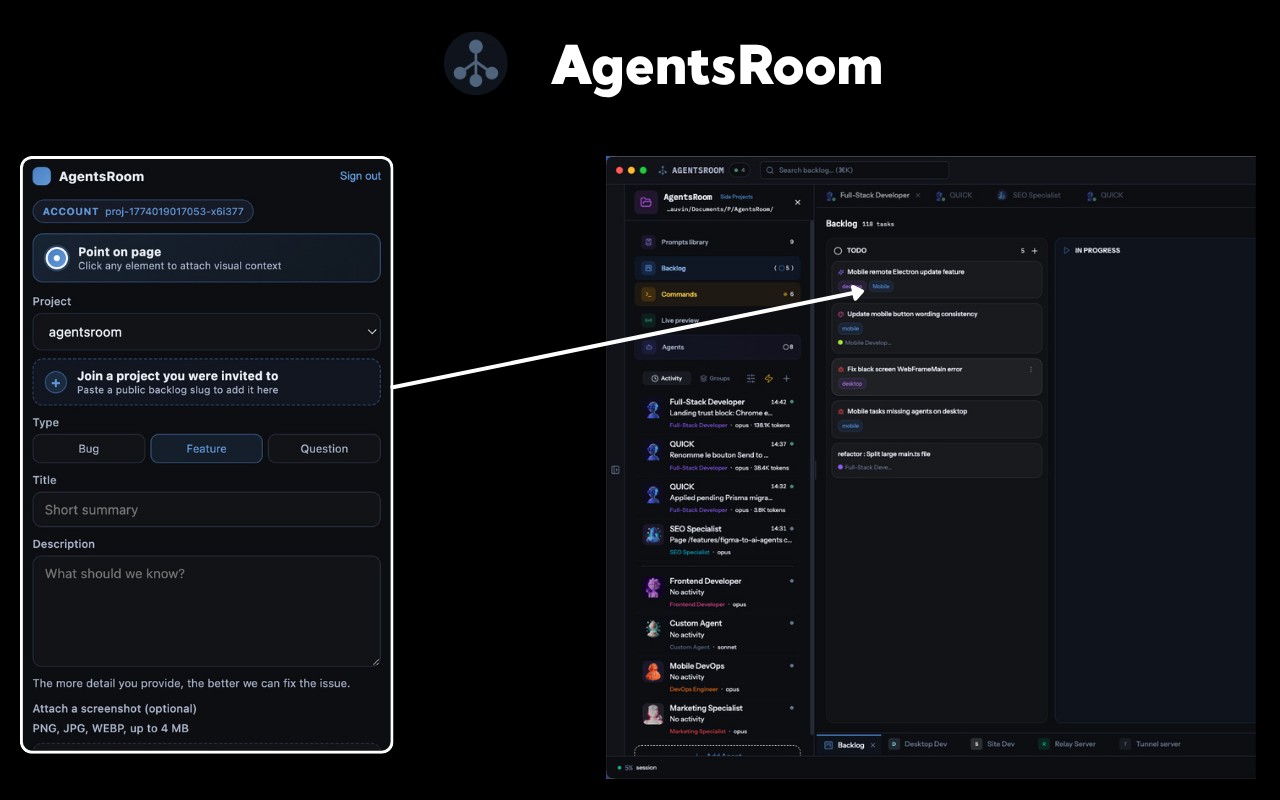
Public-facing backlog portal, client feedback, upvotes, private access, embeddable widget and a Chrome extension — all synced with your AI agents.
How the remote backlog works
Create and configure your backlog
From your AgentsRoom project settings, open the Remote Backlog tab. Pick a slug, choose the visibility mode (public, unlisted, restricted), toggle write access and upvotes, pick the default agent role to assign to incoming tickets, and configure the client-facing status labels.
Share the link, widget or Chrome extension
Copy the public URL, scan the QR code during a client meeting, drop the widget on your landing page, or ask your clients to install the AgentsRoom Chrome extension so they can report bugs from anywhere on the web with one click.
Clients submit tickets
They pick bug, feature request or question, add a title, a description, an optional priority, and hit submit. Their ticket lands directly in your backlog with source = user_feedback, tagged with their email, their user-agent, and the URL they were on when they reported it.
Your AI agents pick them up
The desktop app lights up with an unread badge on the Remote Feedback filter. Drag the ticket into In Progress and a Claude, Codex, OpenCode, Gemini CLI or Aider agent starts coding immediately, with the context your client provided.
Ship, notify, close the loop
When the agent is done and you reviewed the diff, move the ticket to Done. A modal asks whether to notify the client; one click and they receive a branded email with the resolution summary. Your client is in the loop, your backlog is always fresh.
Because none of them talk to your AI agents
Linear, Jira, GitHub Issues, Canny, Featurebase, Fider, Trello, ClickUp — they all store tickets. AgentsRoom Remote Backlog stores tickets AND wires them directly into your Claude Code, Codex CLI, OpenCode, Gemini CLI or Aider agent pool. When a client reports a bug at 11pm, your AgentsRoom agent can pick it up, fix it and tag you on Slack before you finish dinner. No integrations to build, no webhooks to wire up, no Zapier in the middle.
FAQ
Can my clients vote on tickets?
Yes. Every ticket on a public or unlisted remote backlog exposes an upvote button. Each email address can upvote a ticket once, clients cannot upvote their own tickets, and you can disable upvotes entirely in the settings if you prefer. Upvote counts are visible to everyone so you can use them to prioritize your sprint.
How is restricted access enforced?
In restricted mode, only the email addresses you explicitly add to the allow-list can access the backlog. When they visit the public URL, they are asked for their email, we send them a magic link (HMAC-signed, 24h validity), and a signed cookie identifies them on subsequent visits. Remove them from the list and they lose access immediately.
What happens when I rename the slug?
We keep a 30-day 301 redirect from the old slug to the new one. All existing public links, bookmarks, QR codes and embeds keep working through that transition period so you never break inbound links or lose SEO juice.
Can I embed the feedback form on my own website?
Yes. Drop a 3 KB script tag pointing at your backlog slug and it adds a floating Feedback button that opens the form in an iframe. Works on any stack (React, Vue, plain HTML, WordPress, Wix). You can also use the direct iframe URL if you prefer to position the widget yourself.
Does the Chrome extension work on my own projects?
Yes. Sign in with your AgentsRoom account and the extension lets you file tickets directly into any of your own projects — not just public backlogs. Great for filing internal bug reports during QA passes without leaving the browser.
Is there a free tier?
Yes. Free plan users can expose one remote backlog with up to 50 client tickets per month. Pro unlocks unlimited backlogs, unlimited tickets, the Chrome extension for multiple projects and the embeddable widget on unlimited domains.
Does this replace Linear, Jira or GitHub Issues?
It depends on your setup. If your team already lives in Linear and you only need a client-facing intake surface, use AgentsRoom Remote Backlog as the intake and keep Linear as the internal tracker. If you already use AgentsRoom as your primary backlog for AI agents, Remote Backlog is your complete client portal without a second tool in the loop.
You may also like
Figma to AI agents: ship designs in one drag
Capture any Figma frame with the AgentsRoom Chrome extension, drop a ticket in your backlog, and let a Claude, Codex or Cursor agent implement it pixel-perfect.
Public AI agents: showing your clients what your bots are up to
How exposing your AgentsRoom backlog turns silent AI work into visible progress your clients can trust, cite and share.
Client-driven AI backlog: let users write your sprint
Stop rewriting WhatsApp messages into tickets. When clients type directly into your backlog, your agents are one drag away from executing.
Feedback-driven AI development: shipping from user voices
A practical look at building software where the prioritization signal comes from end-users upvoting tickets in a public backlog, not from a product manager's gut.
An AI-powered client portal for agencies and solo devs
Why a remote backlog is the simplest client portal you will ever build — no SaaS subscription, no custom code, no feature creep.
Turn your backlog into a feedback engine
Download AgentsRoom, expose your first project in under a minute, and let your clients drive your AI agents.
Companion app: monitor your agents on the go
Works with Claude, Codex, OpenCode, Gemini CLI, and Aider
Also on Chrome: install the AgentsRoom extension to push bugs and requests straight to your public backlog.